











Most people in the e-mobility space still associate OCPI (Open Charge Point Interface protocol) with roaming, not with payments at the charger. In the Nayax Energy EV Kiosk, OCPI became the key to running card present charging payments, without requiring the CSMS (Charging Station Management System) to have any understanding at all of the payment workflows.
The goal of the architecture was to:
- Enable charge point operators (CPOs) to offer familiar payment experiences (card, mobile wallet, loyalty) at the charging station.
- Keep the CSMS focused on charging logic and operations, not on Payment Service Provider (PSP) integrations, PCI scope, or terminal management.
- Use OCPI as the abstraction layer needed between the payment terminal provider (PTP) and the CSMS.
- Promote the Nayax payment terminal for drivers.
How the Nayax EV Kiosk uses OCPI
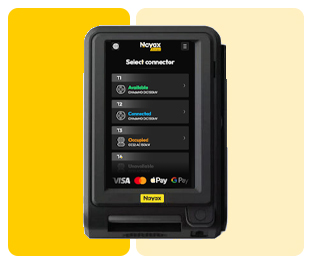
Nayax Energy EV Kiosk is a hardware-agnostic EV charging and payment kiosk that uses OCPI as its connectivity protocol. Rather than requiring a terminal on every charger, one kiosk can serve multiple chargers in the same location, while remaining independent of specific charger brands.
In this architecture:
- The CSMS acts as the CPO in OCPI sharing locations, chargers (EVSEs), connectors, statuses, and tariffs.
- The Nayax platform acts as PTP managing payment terminal, user interactions, and card/ mobile wallet processing.
- The EV Kiosk UI lets the driver choose the connector, starts the payment on the Nayax terminal, and then triggers a session via OCPI toward the CSMS.
- When the session ends, OCPI CDR (Charge Detail Records) is sent to the PTP to align settlement and reporting data.
From the CSMS’s perspective, this is “just” a standard OCPI-driven session with tariffs and CDRs; it does not need to own card schemes, EMV logic, or refund handling.
Why this pattern matters for CPOs and platforms
For CPOs and platform providers, this OCPI pattern unlocks several advantages:
- Reduced complexity: one integration pattern can be used for many payment terminals and PSPs, instead of custom APIs being required for each vendor.
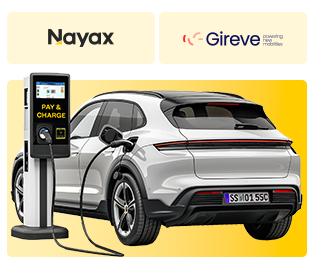
- Retrofit friendly: a kiosk can be added to existing chargers, without rewiring or changing the OCPP/CSMS stack.
- Futureproofing: as OCPI evolves, new capabilities (e.g., better terminal assignment, richer tariffs) can be adopted, without rewriting the whole CSMS or terminal firmware.
In the Nayax Energy EV Kiosk rollout, this architecture made it possible to support multiple sites, partners, and markets, while keeping the same OCPI-based integration surface for each CSMS. This translates into faster deployments, fewer customized projects, and a cleaner separation of responsibilities between “charge” and “pay”.
Closing thought (and invitation to connect)
Designing and delivering the Nayax Energy EV Kiosk showed how powerful OCPI can be beyond roaming – especially when used to decouple payments from the CSMS. For anyone building EV platforms, payment terminals, or CSMS solutions, now is the right time to treat the OCPI payments module as a first-class component of your architecture, not an afterthought.
If you are working on EV charging, payments, or OCPI/OCPP integrations and want to discuss this pattern (or compare approaches), feel free to reach out to us here.